Silversword. It's fun when you can combine your two favorite research interests (conservation and remote sensing) into one project, then place it in an island paradise! Working with Tim Warner (Department of Geology and Geography), Rick Landenberger (now of West Virginia View) and I initiated this project, which has further developed remote sensing censusing of a rare, endangered species - Argyroxiphium sandwicense) on the barren volcano of Haleakala, Maui. Our work showed that for plants larger than ca. 5 - 10 cm, we can reliably census plants from a helicopter. The advantage of this approach is that no one has to trample the delicate cinders of the crater to census the populations, the census is spatially explicit, and one can census >90% of the area containing ca. 30,000 silverswords in a few dozen images. We have shown that we can distinguish silverswords from most other objects seen from above with automated image processing. Further, by using the IR band, we can distinguish dead from live swords. Detecting population change in these plants is the next step. This is likely to be extremely timely as two forces appear to be potentially impacting N in a detrimental way: First, Argentine ants are invading the crater and there is strong concern that they will devastate the native pollinator population that are, required by silversword for successful seed production. Second, recent consecutive drought years appear to be taking their toll in reduced flowering and increased mortality, with significant declines in numbers of plants in monitored plots. Finally, we believe remote sensing may provide important data for evaluating hybridization of silverswords with close relatives (e.g., Dubautia). At the present time, we do not have funding to continue this work, but it remains of interest and seems to be one of the most promising avenues of research to connect remote sensing and demography.
| Haleakala silversword (Argyroxiphium sandwicense) image from oblique angle | 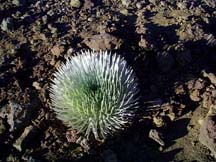 |
Below is one of the helicopter platform images taken in October, 2000.
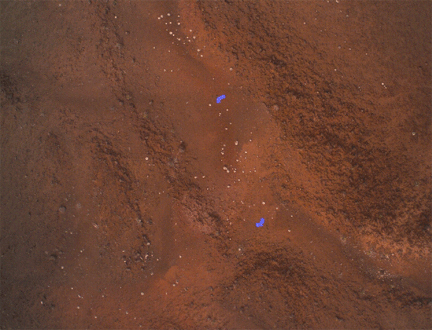 |
This is a much-reduced image of a silversword population taken from a helicopter. The white specks are silversword individuals, which often stand out spectrally from the lava flow background. The blue flagging marks the corner of National Park Service Monitoring plots. We have compared (a) 'ground truth' data, (b) photointerpreter output, and (c) output from automated image processing algorithms. Ultimately, we are testing the limits of current remote sensing tools for monitoring rare plants such as silversword. |
Hemlock. In December, 2003, Rob Lamar completed his Ph.D work under my direction on the same issues with studies of hemlock in Shenandoah National Park. In the study area, hemlock is rapidly dying due to the introduced pest, hemlock woolly adelgid. We believe remote sensing can be used to spatially map hemlock mortality over a large scale, thus improving our understanding of why hemlock dies rapidly in some areas but not in others when hit by adelgid outbreaks.
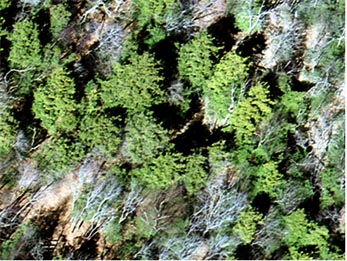 |
Winter aerial photograph of hemlock stand (partial photo) showing living individual trees. |
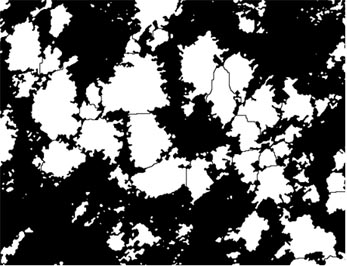 |
Same image after image processing using watershed segmentation algorithm developed by Rob Lamar |
Forest Trees. The exciting prospects for the methodological advances possible in a marriage of plant population biology with remote sensing of forests fall into two classes: (1) detection of rare individuals or communities - what I call the 'needle in a haystack' problem, and (2) detection of large-scale change in common elements of the forest.
Detection of rare individuals could be invaluable in terms of both conservation of rare species and restoring now-rare species to their former prominence. For example, we have been investigating whether there are spectral signatures of American chestnut. While they were once one of the most common (and valuable) of all eastern deciduous forest trees, the exotic chestnut blight obliterated this species earlier in this century. Nevertheless, occasional large individuals remain in the forest, although any given forester is likely to have encountered only one or two in their lifetimes. Are these rare individuals there because of chance? Or, could they be genetically resistant to the blight? If genetic resistance is rare, the only way to find it would be by screening large numbers of individual trees. What is the best way to prospect for large numbers of a rare item in the forest canopy? Remote sensing. The chestnut is just one example of potential applications of bioprospecting. Detection of rare ‘pest’ or ‘exotic’ species, such as Ailanthus, is another application with potentially huge payoffs in terms of conservation – detecting invasions before they are out of control. See my link to Invasive Species for a description of an application to study of invasives (Ailanthus).
At the other end of the rarity scale are common species that are undergoing shifts in abundance due to many possible factors. Global climate change, for example, will have subtle effects over long periods of time. Detecting effects of such change on the forest requires scaling up the censusing of populations to the regional level.
All of this research is timely because it comes on the eve of high spatial resolution satellite remote sensing in the commercial sector. Developing the potential to make maximum use of such data now will position us to take advantage of this capability as it becomes available.
 Back
Back