Consequences of Rapid Environmental Change in the Arctic
 |
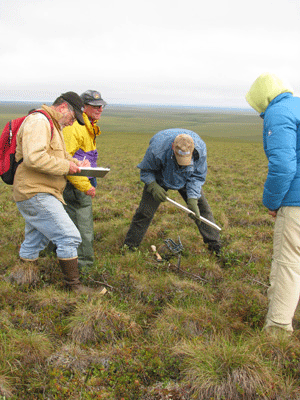 |
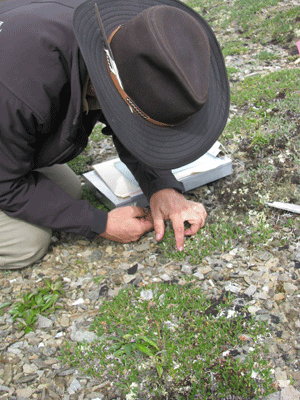
| July 2009. Counting shoots of Dryas octopetala in the fellfield transplant garden set up in 1979 | Gus Shaver, Ned Fetcher, Milan Vavrek, and Cindy Bennington census Eriophorum vaginatum on the north slope in July, 2009 |
Thirty years ago, as a fledgling ecologist, I set up a long-term reciprocal transplant experiment with Dryas octopetala (mountain avens) across a montane snowbank gradient in the tundra northeast of Fairbanks, AK. Meanwhile, one year later, my friends/colleagues/mentors Ned Fetcher and Gus Shaver were setting up a similar experiment with Eriophorum vaginatum (cottongrass) across a latitudinal gradient along the pipeline haul road. At intervals, we have censused these experiments during the last 30 years. In Fall, 2008, I realized that these experiments provide an ideal opportunity to study the possibility of 'adaptational lag' - the delayed genetic response to rapid climate change that could limit the potential response of tundra systems to rapid warming. The basic premise is that locally adapted ecotypes may no longer be locally optimal phenotypes since the climate has directionally changed so rapidly in the last 30 years. Moreover, ecotypes transplanted from the south or lower elevations may now be better adapted to environments farther north (or upslope) than local populations. We can test these hypotheses by re-examining plant performance in the two experiments.
In late July, 2009, we did a reconnaissance trip to Alaska to assess the condition of the gardens. In 2010, we mounted an expedition to all of the transplant sites and censused our populations, making supplementary physiological, growth and flowering measurements on remaining individuals. In 2011 we will perform our final census and harvest to determine performance in today's environments. Both undergraduate and graduate students are involved in the project in a collaboration that provides new research experiences for both.
This project is funded by the National Science Foundation with American Recovery & Reinvestment Act funds.
 Back
Back